Key Takeaways
Polymarket paid over 1,100 creators to film fake bets totalling $1.9 million — none of it was real. If you saw viral "big win" videos, you were likely watching paid fiction.
Prediction markets face three structural problems that go beyond marketing: oracles can be tampered with, insiders can trade on secret information, and resolution rules can be disputed. These risks affect your money directly.
Despite the scandal, Polymarket is now federally legal in the US and backed by billions in institutional investment. The platform is not going away, but it badly needs reform — and you need to understand these risks before trading.
What Is This All About?
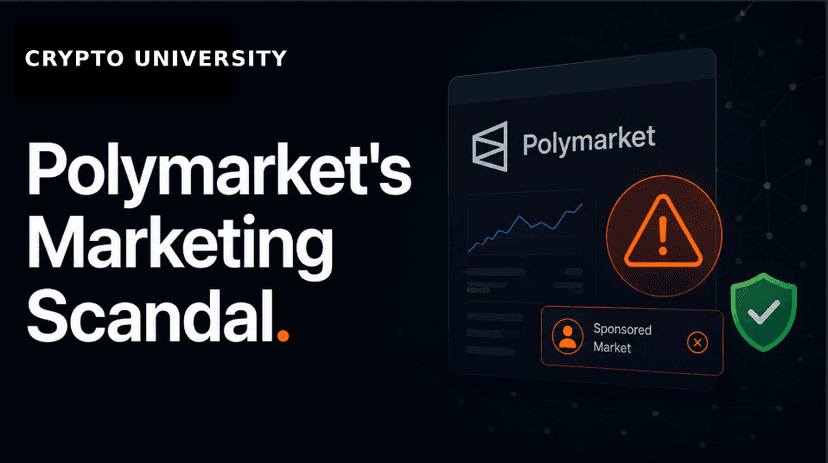
In June 2026, the Wall Street Journal revealed that Polymarket, the world's largest prediction market, had been secretly paying social media creators to film fake bets and fabricated big wins. The videos were made on near-perfect replica versions of the Polymarket website. The hashtag PolyScam went viral almost immediately.
But here is the thing: the marketing scandal is just the most visible problem. Underneath it are deeper vulnerabilities that every prediction market faces. This article breaks them all down in plain English, so you know exactly what you are getting into if you trade on platforms like Polymarket.
How Polymarket Actually Works
Think of Polymarket like a betting market for real-world events. Every market is a yes/no question, for example: Will the Fed cut rates this month? Will a company sell its Bitcoin by a deadline?
You buy shares that represent a probability. If shares trade at $0.60, the crowd thinks there is a 60% chance the event happens. A correct bet pays $1 per share. A wrong bet pays $0.
Two things make Polymarket different from a regular bookie. First, it runs on the Polygon blockchain, which means every single trade is public and auditable. Anyone can check. Second, markets do not settle themselves. They rely on an oracle, which is an outside mechanism that confirms what actually happened in the real world. Polymarket uses UMA's optimistic oracle, where anyone can challenge an outcome, and if there is a big enough fight, token holders vote on it. That oracle is both Polymarket's clever design and its biggest weak spot.
Regulatory History: Banned, Then Back
Polymarket was blocked from US users in 2022 after the CFTC fined it $1.4 million for running an unregistered event-contract market. For nearly four years, US users could only access it through a VPN.
In 2025, Polymarket bought QCEX, a CFTC-licensed derivatives exchange, for around $112 million. That acquisition gave it the same legal status as major futures exchanges. It relaunched for US users in December 2025. As of mid-2026, it is federally legal, although several states still argue it is essentially gambling under their own laws. That state-vs-federal battle is the live legal fight for the entire prediction market industry.
One important detail: the fake video campaign ran from roughly December 2025 to May 2026, right during the relaunch period, and was deliberately aimed at American audiences. Bad timing for a company trying to build a clean reputation.
Key Numbers at a Glance
Figure / Event | What It Means for You as a Trader |
$1.9M in fake bets (1,100+ videos) | Creators were paid to show wins that never happened — don't trust influencer bet screenshots. |
$34,000 weather bet payouts (Paris sensor) | A single tampered sensor settled real money bets. Oracle quality matters. |
$400,000 insider profit (Maduro capture) | A US soldier bet on secret military intel. Prediction markets can be abused like stocks. |
MicroStrategy Bitcoin dispute (tens of millions) | Ambiguous market rules cost traders big. Always read resolution criteria before betting. |
$2B institutional investment (ICE / NYSE parent) | Big money is flowing in. The platform isn't going away, but it needs reform. |
Vulnerability 1: The Oracle Problem
The most fundamental weakness in any prediction market is that settling bets on-chain is only as reliable as the off-chain data source used to confirm the result. In April 2026, this became very literal.
Polymarket ran daily markets on the high temperature in Paris, using a Météo-France sensor at Charles de Gaulle airport. On two separate days, that sensor recorded sudden temperature spikes that no nearby station detected. Each spike resolved a weather bet, totalling around $34,000 in payouts. Météo-France filed a criminal complaint and alleged equipment tampering. Nobody was identified, and the famous "hairdryer" footage was never authenticated, but meteorologists confirmed the readings were unnatural.
Polymarket's response was to switch to a different airport sensor. That fixes nothing structurally. You still have one physical sensor that anyone could tamper with. The lesson for traders: always check how a market resolves. One data source means one point of failure.
Vulnerability 2: Insider Trading
Prediction markets let you bet on geopolitical events, elections, and government decisions. That creates a new kind of insider trading that traditional financial law was not built to handle.
The clearest example happened in January 2026. Days before the US operation that captured Venezuelan leader Nicolás Maduro was made public, a brand new Polymarket account bet about $33,000 that Maduro would be removed from power that month. The account collected over $400,000 in profit. The DOJ indicted Gannon Van Dyke, a US Army Special Forces master sergeant who had helped plan and execute the operation, for commodities fraud and wire fraud. He faces up to 20 years and has pleaded not guilty. This is considered the first insider-trading prosecution tied to a prediction market. The CFTC filed a parallel civil case.
Polymarket says it flagged the suspicious trade and referred it to authorities. That is worth something. But the platform cannot screen trades before they happen. The lesson: anyone with private government or military knowledge can legally place a bet before you can know what they know.
Vulnerability 3: Dispute Resolution
Before PolyScam became a hashtag, it started as a trading dispute that made a lot of people furious.
A market asked whether MicroStrategy, now called Strategy, would sell any Bitcoin by May 31. The company did sell 32 Bitcoin before the deadline, but it only disclosed the sale in an official filing the following day. That gap split traders: did the market resolve based on when the sale happened, or when it was publicly confirmed?
Polymarket added guidance favouring a No resolution, arguing that public confirmation arrived after the deadline. The dispute became one of the largest in UMA's history, with tens of millions in open interest. Traders on the Yes side, including one who reportedly lost around $500,000, argued the rules had been changed after the fact.
The point here is not who was right. It is that as prediction markets handle bigger and messier real-world events, resolution rules get murky, and token-weighted voting makes small traders feel powerless. Reported disputes on Polymarket rose sharply in 2026.
The Core Scandal: They Manufactured Credibility
Now for the headline story. The Wall Street Journal reviewed more than 1,100 videos from a set of paid creators and found roughly $1.9 million in displayed bets that were completely fake. Creators filmed on near-perfect replicas of the Polymarket site, including one hosted at a lookalike domain. They were reportedly paid $2,000 to $3,000 a month and told not to disclose the arrangement.
Across one group of 118 videos, creators celebrated nearly $900,000 in fabricated winnings. In reality, those positions would have lost more than $166,000 on the real platform.
A marketing contractor amplified the videos with paid commenters to simulate organic buzz, and creators only got paid when at least 60% of their audience was US-based. The campaign reportedly reached over 140 million views.
Why does this matter beyond the obvious? Polymarket's entire value proposition is that its prices reflect genuine crowd belief. When the platform manufactures fake activity to make itself look popular, it directly contradicts the thing it is selling. It is not just bad marketing — it undermines the product itself.
Why This Matters Right Now
Three things make this more than a reputational problem for Polymarket.
First, disclosure law. In the US, paying influencers to promote a product without disclosure violates FTC rules. Fabricated promotions invite regulatory action precisely when Polymarket is trying to build a clean US presence.
Second, institutional money. Intercontinental Exchange, the parent company of the New York Stock Exchange, has committed roughly $2 billion to Polymarket, valuing it near $9 billion. Institutions use prediction market prices as real-time signals. Manufactured engagement raises serious questions about how seriously the platform treats market integrity.
Third, sector-wide regulation. This scandal lands right as state courts are litigating prediction markets and Congress is debating new bills covering insider trading, death markets, and war-related contracts. Polymarket's mistakes become arguments in that policy fight.
The Bottom Line
PolyScam is not one failure. It is a pile-up of structural risks that come with running a large on-chain prediction market: oracles that can be gamed, insider trading that the law is still catching up to, resolution rules that break down under real-world complexity, and a marketing economy that rewards fake social proof.
None of these are unique to Polymarket. It is simply the largest and most visible example of each. The open questions for the sector: Will oracle and settlement designs become more manipulation-resistant? Will regulators treat fabricated promotions as enforcement matters? And can a market whose entire product is true survive being caught manufacturing it?
How those questions are answered will determine whether prediction markets grow into serious financial infrastructure or stay, as critics say, a casino wearing the costume of an oracle.
Frequently Asked Questions
Is Polymarket legal in the US?
Yes, as of December 2025. Polymarket acquired a CFTC-licensed exchange (QCEX) and relaunched a compliant US entity. Some states still contest it at the state level.
What is the oracle problem?
Prediction markets need an outside source to confirm real-world results. If that source is tampered with (like a weather sensor), the wrong outcome can get paid out.
Can I be a victim of insider trading on Polymarket?
Yes. As the Maduro case shows, people with private government or military information can profit. There is no pre-trade screening on-chain.
What is #PolyScam?
A hashtag that went viral in June 2026 after the WSJ revealed Polymarket paid over 1,100 creators to film fake bets on replica websites, totaling $1.9M in fabricated wins.
How are disputes resolved?
Polymarket uses UMA's optimistic oracle. If traders disagree on an outcome, it escalates to a token-holder vote. Critics say this favours large token holders.
Should I use Polymarket?
It is the largest and most liquid prediction market. But understand the risks: oracle manipulation, insider trading, and ambiguous resolution rules are real. Never bet more than you can afford to lose.
Disclaimer: This content is for educational and informational purposes only and is not financial advice. Nothing here is a recommendation to buy or sell any asset or use any platform. Do your own research and manage your risk.
Quantum Computing and Bitcoin Security: What the Q-Day Prize Result Means for Crypto
On-Chain Analytics for Beginners: How to Use Nansen, Arkham Intelligence, and Token Terminal
How to Research a New Crypto Project: A 10-Point Due Diligence Framework
SEC Project Crypto Explained: Atkins’ Token Taxonomy and the Innovation Exemption