Key Takeaways
|
The Clip That Started It All
Picture the perfect viral moment. A young creator is on camera, watching a six-figure payout land because the President of the United States said the word "McDonald's." A hundred thousand dollars. Real money, a real platform, real proof that anyone could do this.
Except none of it was real. Not the win. Not the bet. Not even the website.
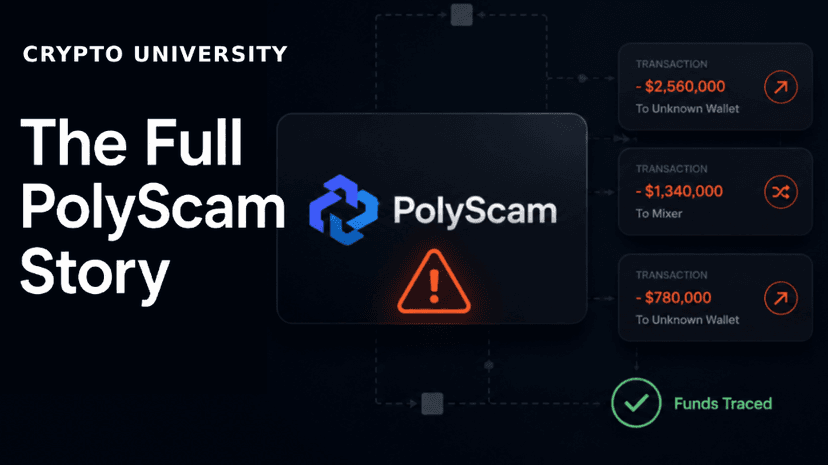
That clip, and more than a thousand like it, is now the center of the biggest credibility crisis prediction markets have ever faced. The internet calls it #PolyScam. And once you understand how it worked, you won't be able to unsee it.
What Is Polymarket, and Why Does It Matter?
If you've been anywhere near crypto in the last two years, you've probably heard the name. Polymarket is a prediction market. Instead of betting on cards or a football score, you bet on real-world events.
Will the Federal Reserve cut interest rates this month? Will one country invade another? Will a public company sell its Bitcoin by Friday? Every question resolves to a simple Yes or No. Every share trades between one cent and ninety-nine cents, and a correct call pays out one dollar.
The pitch sounded almost poetic: the crowd is wiser than the experts, and the market sees the truth before the headlines do. During the 2024 US election, Polymarket called Trump's win while pollsters were still hedging, and the platform rocketed from a crypto curiosity to a mainstream name overnight.
Milestone | Detail |
|---|---|
2024 US Election | Polymarket called Trump's win before major pollsters did |
Late 2025 Valuation | Parent of New York Stock Exchange invested ~$2 billion; platform valued near $9 billion |
December 2025 | Relaunched in the US as a regulated exchange after acquiring QCEX for ~$112 million |
2022 CFTC Fine | $1.4 million fine for running an unregistered market; US users blocked |
Banned in America, Then Back Through a Side Door
Here's the history Polymarket would rather you skip. For years, the platform was flat-out illegal in the United States. In 2022, the CFTC (the US derivatives regulator) fined the company $1.4 million and forced it to block American users for running an unregistered market. If you were in the US, your only way in was a VPN.
So Polymarket didn't fight its way back in through the front door. It bought the door. In 2025 it acquired a small, already-licensed US derivatives exchange called QCEX for about $112 million, inherited the regulatory license that came with it, and quietly relaunched in America in December 2025 as a regulated exchange.
Banned, then back, through a side entrance. Keep that in mind, because the scandal that followed targeted the exact American audience the platform had spent years officially shutting out.
Manipulation Was Always the Pattern, Not a One-Off Glitch
Before the big bomb dropped, there was already a troubling pattern. Here are the three cases you need to know about.
The Paris Thermometer Trick
In April 2026, the temperature sensor at Charles de Gaulle airport spiked twice, on two separate days, to readings that no nearby weather station recorded. Each spike conveniently settled a Polymarket weather bet, for around $34,000 total.
France's national weather service, Météo-France, was suspicious enough to file a criminal complaint over tampered equipment. Online sleuths claimed someone walked up to the sensor with a battery-powered hairdryer. The footage was never authenticated, but meteorologists were clear: the spike could not have happened naturally.
The lesson: you can build an unbreakable blockchain, but you cannot decentralize a thermometer.
The Soldier Who Knew Too Much
This one is far more serious. In January 2026, US forces captured Venezuelan leader Nicolás Maduro in a classified raid. Days before it became public, a brand-new Polymarket account placed roughly $33,000 on Maduro being out of power by month's end, and walked away with more than $400,000.
According to a US Department of Justice indictment, the trader was a US Army Special Forces master sergeant named Gannon Van Dyke, who helped plan and execute the operation. He was arrested and indicted on charges including wire fraud and commodities fraud. He faces up to 20 years in prison and has pleaded not guilty. It is believed to be the first insider-trading case of its kind on any prediction market. To Polymarket's credit, the company says it flagged the trade and referred it to authorities.
The Journalist Pressure Campaign
Traders also allegedly tried to pressure a journalist into changing his published reporting so their bet would resolve in their favor. Manipulation here is not an occasional glitch. It is a strategy people have learned to actively pursue.
Incident | What Happened | Financial Impact |
|---|---|---|
Paris Thermometer | Airport sensor spiked suspiciously twice; criminal complaint filed by Météo-France | ~$34,000 in settled bets |
Insider Trading (Van Dyke) | US Army soldier bet on classified raid he helped plan; DOJ indictment followed | $33,000 bet → $400,000+ payout |
Iran Strikes | Large windfall tied to US strikes on Iran before public confirmation | ~$500,000 profit reported |
Journalist Pressure | Traders allegedly tried to influence a journalist's published article to change bet outcome | Unquantified |
The Spark: A Bitcoin Technicality That Became a Movement
The thing that turned grumbling into a full-blown movement was, in isolation, almost petty. A market asked: Will MicroStrategy sell any Bitcoin by May 31?
The company did sell 32 coins, before the deadline. But it didn't disclose the sale until the following day, in a regulatory filing called an 8-K.
Leaning on that timing gap, Polymarket steered the market toward a No resolution, meaning it did not pay out the Yes bettors. Tens of millions in open positions hung on a few hours of paperwork. Traders who had bet Yes after watching the company confirm the sale were told they had lost. One of the largest Yes holders said he had been wiped out of roughly half a million dollars and publicly called the platform a "bucket shop."
The hashtag #PolyScam was born. And it spread fast. That was the kindling. Three weeks later came the fire.
The Wall Street Journal Investigation: The Full Picture
In June 2026, The Wall Street Journal published an investigation that no amount of PR could spin away. Here is what the reporters found.
Finding | Detail |
|---|---|
Total videos reviewed | More than 1,100 promotional videos |
Total fabricated wagers shown | ~$1.9 million across all clips |
Reality check on those bets | Not one bet was real |
Creator pay | ~$2,000–$3,000 per month |
Disclosure requirement | Creators were reportedly told NOT to disclose the paid arrangement |
Fake websites used | Polymarket built near-perfect replicas of its own site (e.g. poiymarket.com) |
Sample of 118 videos | Celebrated ~$900,000 in fake wins; real bets would have lost $166,000+ |
Audience targeting | Creators only paid when 60%+ of their audience was American |
Total views | More than 140 million views |
The McDonald's clip? The Trump footage was two months old. He never said that word during the bet's time window. Every real person who bet on that same question lost.
The campaign ran through a marketing firm that, according to the reporting, also deployed a network of paid commenters to make the videos look organic. Separately, Polymarket's own marketing chief was found to have been paying creators from a personal PayPal account without labeling it as advertising.
Sit with the irony for a moment. A company whose entire purpose is to show you the unfakeable wisdom of the crowd got caught manufacturing the crowd.
This Is the Oldest Trick in the Gambling Business
Here is where the dots connect, and you might not love it. This technique is not new, and it is not unique to Polymarket.
Every time you see a famous face dropping a million dollars on a single bet during a livestream, every time an influencer posts a screenshot of a massive win, ask one question: who profits if I believe this?
When the platform is paying the creator, that person's win or loss is irrelevant. The point was never the bet. The point was you, watching, feeling the itch, thinking that could be me.
Some of these big public bets are real. Some are house money. Some are pure theater. The machine doesn't care which, because what's actually being sold isn't a prediction. It's your engagement, your FOMO, and eventually your deposit. Polymarket just got caught building that factory in the open. The only thing separating it from others in the industry is a Wall Street Journal investigation.
Suffering from Its Own Success
That is the real story here. Polymarket became a victim of its own ambition. It took $2 billion from the people who own the New York Stock Exchange. It clawed its way back into America dressed as a clean, regulated exchange. And at the precise moment it needed to look legitimate, it got caught running a fake-bet operation aimed at US users, with undisclosed ads, on counterfeit copies of its own website.
That is not just embarrassing. In the US, paying influencers to push a product without disclosure sits squarely in the FTC's wheelhouse. Building fake versions of your site to stage fake wins, while courting federal regulators for a license, is the kind of thing that gets read very carefully by people with subpoena power. States are already circling, and lawmakers are already drafting bills aimed at prediction markets.
So the question now is simple. When the dust settles on #PolyScam, does this end with a fine and a polished press release, or does it end in a courtroom? That answer is still being written.
Frequently Asked Questions
Is Polymarket legal in the United States?
As of December 2025, yes. Polymarket acquired a licensed US derivatives exchange and relaunched stateside as a regulated platform. Before that, it was banned for American users following a $1.4 million CFTC fine in 2022.
What is PolyScam?
It's a hashtag that went viral after Polymarket ruled against bettors in a MicroStrategy Bitcoin sale dispute. It later became the umbrella term for the broader scandal, including the Wall Street Journal's investigation into fake influencer videos.
Were people actually arrested over Polymarket?
Yes. US Army Special Forces master sergeant Gannon Van Dyke was indicted by the DOJ for allegedly placing bets on a classified military operation he helped plan. He faces up to 20 years in prison and has pleaded not guilty.
Are the influencer videos on social media for Polymarket real?
Many are not. The Wall Street Journal reviewed over 1,100 videos and found that none of the bets shown were real. Creators were paid $2,000 to $3,000 a month to film themselves on fake replica websites, celebrating wins that never happened.
Should a beginner use Polymarket?
That is your decision to make, but go in with eyes open. The concept of prediction markets is legitimate and can be intellectually interesting. However, the platform has active documented cases of insider trading, market manipulation, and a large-scale deceptive advertising campaign specifically targeted at new US users. If you do engage, never risk money you cannot afford to lose, and treat any big win you see online with serious skepticism until you can verify it independently.
What is a prediction market, in plain English?
It is a platform where you buy and sell shares on the outcome of real-world events. If you believe something will happen, you buy a Yes share for less than $1. If it happens, your share pays out $1. If it does not, your share pays out nothing. Think of it less like gambling on a slot machine and more like making a bet on a news headline.
Could Polymarket face more legal trouble?
Quite possibly. US regulators including the FTC have clear authority over undisclosed paid advertising. The DOJ is already involved through the Van Dyke insider trading case. Several US states are actively discussing legislation targeting prediction markets, and the platform's pattern of behavior will likely draw continued scrutiny.
Disclaimer: This content is for educational and informational purposes only and is not financial advice. Nothing here is a recommendation to buy or sell any asset or use any platform. Do your own research and manage your risk.
Real-World Asset Tokenization Hits $31 Billion: What It Means for On-Chain Finance
The Crypto Anti-Phishing Checklist: 12 Habits That Stop Wallet Drainers in 2026