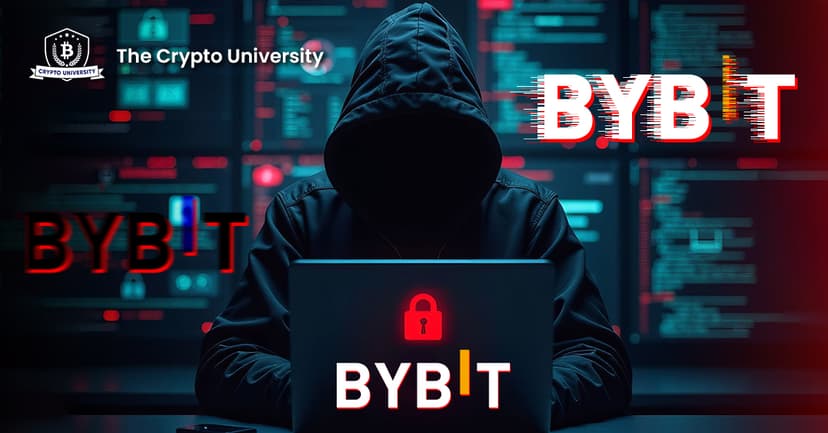
In February 2025, the crypto world was shaken by one of the largest thefts in its history. Hackers from the North Korean Lazarus group, successfully stole approximately $1.5 billion worth of Ethereum from Bybit’s cold wallet, marking a new high in crypto heists. This breach didn’t just expose vulnerabilities in Bybit’s security systems, it underscored systemic flaws in how digital assets are protected across the industry.
Crypto Wallets: Outdated Security Models
Despite the rapid evolution of blockchain and decentralized finance (DeFi), crypto wallet security remains stuck in the Dark Ages. Most wallets still rely on **seed phrases** (a list of words used to recover access) and **multisignature (multisig) setups** (requiring multiple approvals for transactions). While multisig offers strong protection, as in the case of Bybit they have glaring weaknesses AKA Smart Contract vulnerability:
Seed Phrases: These can be lost, stolen, or compromised through phishing attacks or malware. They represent a single point of failure, which is dangerous in an industry where billions of dollars are at stake.
Multisig Wallets: Although multisig adds a layer of security by requiring multiple private keys to authorize transactions, it often depends on complex smart contracts which in of itself introduces additional risks. Moreover, apart from SUI blockchain, Tron blockchain, Bitcoin blockchain, most blockchains don’t natively support multisig, making implementation cumbersome and prone to errors.
Ironically, while blockchain technology has revolutionised finance with innovations like DeFi and smart contracts, wallet security feels like it’s still operating in 2010.
Lessons from the Bybit Hack
The Bybit hack was a failure of technology, and human vulnerability. The attackers exploited weaknesses in the multisig system by tricking signers into approving malicious transactions. This was achieved through sophisticated social engineering and user interface manipulation, highlighting that even the most advanced systems are only as secure as their users.
This incident serves as a stark reminder: crypto wallets are not just technical tools, they are human-facing systems. If hackers can deceive users into making mistakes, no amount of backend security can prevent breaches.
Wallets Innovating Beyond Seed Phrases and Multisig
Fortunately, some innovative projects are rethinking wallet security to address these long standing issues:
ZenGo (@ZenGo): This wallet eliminates seed phrases by using Multi-Party Computation (MPC), which splits security responsibilities across multiple parties, ensuring no single point of failure. It also always for inheritance (when/if you die)
Vultisig (@vultisig) uses a Threshold Signature Scheme (TSS) to split private keys into "vault shares" across multiple devices, eliminating the need for seed phrases and ensuring no single device can access funds alone. Users can create secure vaults with customizable setups (like 2-of-3 or 3-of-4 signers), manage assets across various blockchains, and sign transactions securely via encrypted communication between devices.
Infinex (@infinex_app) operates as a non-custodial crypto platform, allowing users to store, swap, and bridge over 1,000 tokens across multiple blockchains like Solana and EVM networks without transaction signing, seed phrases, or gas fees. It uses passkey-secured accounts and onchain-recoverable vaults for enhanced security.
Cypherock (@CypherockWallet): Employs Shamir Secret Sharing to divide private keys into multiple parts, allowing users to recover funds even if one piece is lost. It also always for inheritance (when/if you die)
Blockstream Jade (@BlockstreamJade)**: A hardware wallet offering air-gapped security to prevent online attacks and multisig.
ELLIPAL Titan 2.0 (@ellipalwallet)**: Another air-gapped wallet that uses QR codes instead of internet connections for added safety.
These wallets prioritize decentralization and non-custodial ownership while introducing cutting edge security measures that reduce reliance on outdated methods.
Why Decentralized and Secure Wallets Are Crucial
The Bybit hack exposes the urgent need for crypto wallets that empower users with full control over their assets while eliminating central points of failure. Decentralised, institution-grade non-custodial wallets with advanced security features are no longer optional; they're essential. As hackers grow more sophisticated, relying on legacy systems like seed phrases and traditional multisig setups is increasingly risky.
A Call to Action for the Crypto Industry
While the crypto space continues to innovate with flashy DeFi applications and cross-chain bridges, wallet security often takes a backseat. This needs to change and must change. The Bybit hack should serve as a rallying cry for developers, crypto enthusiasts and companies to prioritise user protection. Hackers won’t wait for the industry to catch up.
Conclusion
The Bybit hack revealed a fundamental flaw in crypto wallets: human error remains their weakest link. It’s time to move beyond outdated practices like seed phrases and traditional multisig setups. With $1.5 billion gone in a single heist, the stakes couldn’t be higher. Let’s innovate or history will keep repeating itself.