Key Takeaways
Stablecoins aim to hold a steady value, usually pegged to the U.S. dollar, through backing by reserves or mechanisms rather than market speculation alone.
Backing types include fiat assets held off-chain, over-collateralized cryptocurrencies on-chain, physical commodities, or algorithmic supply adjustments, each with different transparency levels.
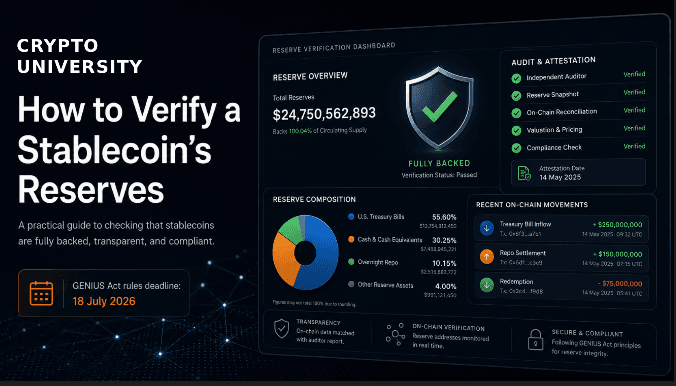
Verification involves reviewing issuer reports and attestations for centralized stablecoins or on-chain data for decentralized ones, plus monitoring the actual trading price against the target peg.
Crypto University helps beginners understand crypto clearly before they risk money.
What Is Stablecoin?
A stablecoin is a type of cryptocurrency designed to maintain a consistent value, most often pegged 1:1 to a fiat currency such as the U.S. dollar. Unlike Bitcoin or other volatile cryptocurrencies whose prices fluctuate with supply and demand, stablecoins prioritize price stability. This makes them useful for trading, payments, and holding value within the crypto ecosystem without constant price swings.
The stability does not happen automatically. It depends on the specific backing or mechanism the issuer or protocol uses to support each token issued. Understanding this backing helps users evaluate how reliably a stablecoin can maintain its peg and what information is available to confirm it.
The Main Types of Stablecoin Backing
Stablecoins fall into several categories based on how they support their value. Here is a breakdown of the primary types.
Fiat-Collateralized Stablecoins
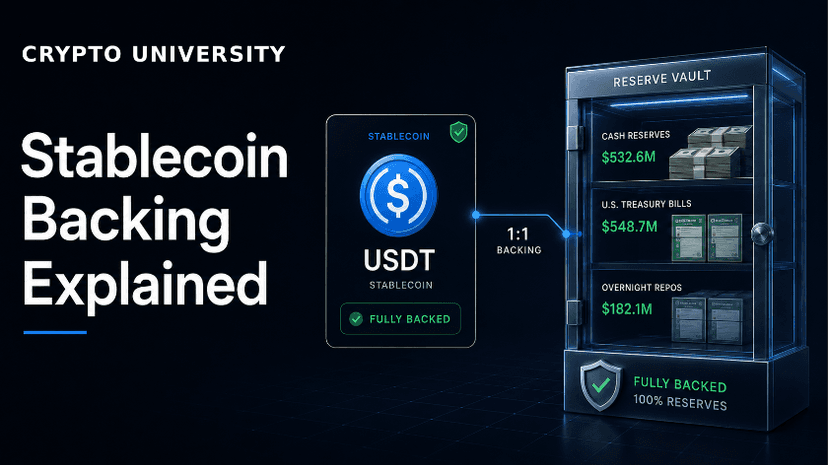
These are backed by reserves of traditional assets held off the blockchain, typically cash, cash equivalents, short-term U.S. Treasury bills, or repurchase agreements. The issuer holds these reserves in custody at banks or financial institutions and issues tokens on a 1:1 basis. Holders can usually redeem tokens directly for the underlying fiat through the issuer.
Major examples include USDC and USDT.
Crypto-Collateralized Stablecoins
These are backed by other cryptocurrencies locked in smart contracts on the blockchain. To mint the stablecoin, users deposit collateral worth more than the stablecoin they receive. This over-collateralization provides a buffer against price drops in the collateral assets. If collateral value falls below required thresholds, automated liquidations occur to protect the peg.
The best-known example is DAI, issued through the Maker protocol (now part of the broader Sky ecosystem).
Algorithmic and Hybrid Stablecoins
These rely primarily on code-based rules and market incentives to adjust supply rather than holding full reserves. When the stablecoin trades above its peg, new tokens are issued; when below, tokens are burned or incentives encourage buying. Some use partial collateral combined with algorithms.
Purely algorithmic designs have shown significant challenges in maintaining stability during stress. Hybrid versions combine some reserves with algorithmic elements.
Commodity-Backed Stablecoins
These are backed by physical assets such as gold stored in vaults. Each token represents a claim on a specific amount of the commodity. Redemption options may include physical delivery in some cases.
An example is PAXG, where each token corresponds to one troy ounce of allocated gold.
Comparison of Major Stablecoins
The table below summarizes key characteristics of prominent stablecoins as of mid-2026. Details can change, so always check official sources.
Stablecoin | Issuer/Protocol | Backing Type | Approximate Circulation (mid-2026) | Transparency Approach | Verification Method |
USDC | Circle | Fiat-collateralized | ~$73 billion | Monthly attestations + weekly disclosures | Third-party assurance by Big Four firm; reserve composition published |
USDT | Tether | Fiat-collateralized | ~$184 billion | Quarterly reserves reports with attestation | Issuer transparency page with asset/liability breakdown |
DAI | MakerDAO/Sky | Crypto-collateralized | Varies (typically tens of billions) | On-chain data only | Blockchain explorers and protocol dashboards for real-time collateral |
PAXG | Paxos | Commodity (gold) | Smaller scale | Monthly attestations | Vault reports and serial number verification for allocated gold |
How Stablecoins Aim to Maintain Their Peg
For fiat-collateralized stablecoins, the main mechanism is arbitrage and direct redemption. If the token trades below $1 on exchanges, users or market makers can buy it cheaply and redeem it with the issuer for $1 in reserves, creating buying pressure. The reverse happens if it trades above $1.
Crypto-collateralized systems use over-collateralization and automated liquidations. Smart contracts monitor collateral values continuously using price oracles. If a position becomes under-collateralized, anyone can trigger liquidation to restore the overall backing ratio.
Algorithmic systems depend on economic incentives and supply changes. These have proven more fragile during extreme market conditions because they lack hard asset backing.
Commodity-backed tokens allow redemption for the physical asset or equivalent value, with storage and audit processes supporting the claim.
No mechanism is risk-free. External factors such as market panic, regulatory changes, or operational issues can still cause temporary deviations from the peg.
How to Verify Stablecoin Backing
Here is a practical, step-by-step approach beginners can follow.
Identify the type and issuer
Start with the stablecoin’s official website or documentation to determine whether it is fiat-backed, crypto-backed, or another category.Check the current trading price
Use aggregators such as CoinGecko or CoinMarketCap to see how closely the token trades to its target (usually $1.00). Persistent or large deviations signal potential issues with backing or confidence.Review official transparency resources
For USDC: Visit Circle’s transparency page for weekly reserve holdings, mint/burn activity, and monthly attestations confirming reserves exceed circulation.
For USDT: Check Tether’s transparency page for daily circulation metrics and quarterly reserves reports that include asset and liability figures along with third-party assurance.
For PAXG: Review Paxos monthly reserve reports detailing allocated gold holdings.
Examine attestation or audit details
Look for reports from independent accounting firms (often described as attestations rather than full financial audits). These confirm that reported reserves meet or exceed tokens in circulation at a specific date. Note the frequency and the firm involved.Inspect on-chain data for crypto-collateralized options
For DAI, use blockchain explorers (such as Etherscan) or dashboards from the Maker/Sky protocol to view total collateral locked in vaults, outstanding DAI, and current collateralization ratios. Liquidation thresholds and oracle prices are also visible.Use third-party analytics platforms
Sites like DefiLlama provide aggregated data on stablecoin market capitalization, trading volume, and some reserve insights. On-chain analytics tools can reveal reserve wallet movements where disclosed.Watch for red flags
Infrequent or missing transparency reports
Heavy reliance on less liquid assets without clear disclosure
History of significant depegs without clear resolution or improved practices
Lack of independent verification
Practical Examples
USDC (Circle) maintains detailed public reporting. Reserves consist of cash, short-term Treasuries, and related instruments held separately from company funds. Monthly attestations by a major accounting firm confirm backing exceeds circulation. Weekly updates show exact holdings and flows.
USDT (Tether) publishes daily circulation figures and quarterly reserves reports showing assets (including cash and Treasuries) exceeding liabilities. Attestations provide third-party confirmation of the reported figures. Excess reserves above circulation have been noted in recent reports.
DAI operates entirely on-chain. Users lock approved collateral (such as ETH or other assets) in vaults to mint DAI. The system targets over-collateralization, with automated liquidations if ratios drop too low. Anyone can verify total collateral and DAI supply directly on the blockchain.
PAXG ties each token to physical gold stored in regulated vaults. Monthly attestations and the ability to verify specific gold bar serial numbers add a layer of commodity-specific transparency.
Common Risks Associated with Stablecoin Backing
Even with reserves or collateral, risks remain. These include:
Counterparty risk with custodians or banks holding reserves
Liquidity risk if large redemptions occur simultaneously
Regulatory changes affecting how reserves can be held or used
Smart contract vulnerabilities in decentralized systems
Historical depeg events, such as the 2022 collapse of the algorithmic TerraUSD (UST), which demonstrated that mechanisms without sufficient hard backing can fail under stress
Users should treat stablecoins as tools with specific risk profiles rather than risk-free cash equivalents.
FAQ
What happens if a stablecoin loses its peg?
Temporary deviations can occur due to market conditions. Persistent depegs may indicate problems with reserves, confidence, or redemption processes. Arbitrage and redemption mechanisms usually work to restore the peg over time, but recovery is not guaranteed.
Are attestations the same as full audits?
Attestations focus on specific claims (such as reserves versus circulation) at a point in time. They are narrower than full financial statement audits of the entire company. Many issuers use attestations for ongoing transparency.
Can I redeem stablecoins for actual dollars or assets?
For major fiat-backed stablecoins, authorized users or institutions can typically redeem through the issuer. Retail users usually sell on exchanges. Commodity-backed options like PAXG may offer physical redemption under certain conditions.
How often should I check stablecoin backing?
For active use or larger holdings, review transparency updates when released and monitor price stability regularly. For occasional use, periodic checks of official reports suffice.
Are all stablecoins equally transparent?
No. Fiat-collateralized ones vary in reporting frequency and detail. Crypto-collateralized ones offer real-time on-chain visibility. Algorithmic ones depend more on code and incentives, with less direct asset backing to inspect.
What tools help verify on-chain collateral?
Blockchain explorers, protocol-specific dashboards, and analytics platforms like DefiLlama allow users to view locked collateral, outstanding supply, and health metrics without relying solely on the issuer.
Disclaimer: This content is for educational and informational purposes only and is not financial advice. Nothing here is a recommendation to buy or sell any asset or use any platform. Do your own research and manage your risk.
What Is a Liquidity Pool? How AMMs Replace Order Books