Key Takeaways
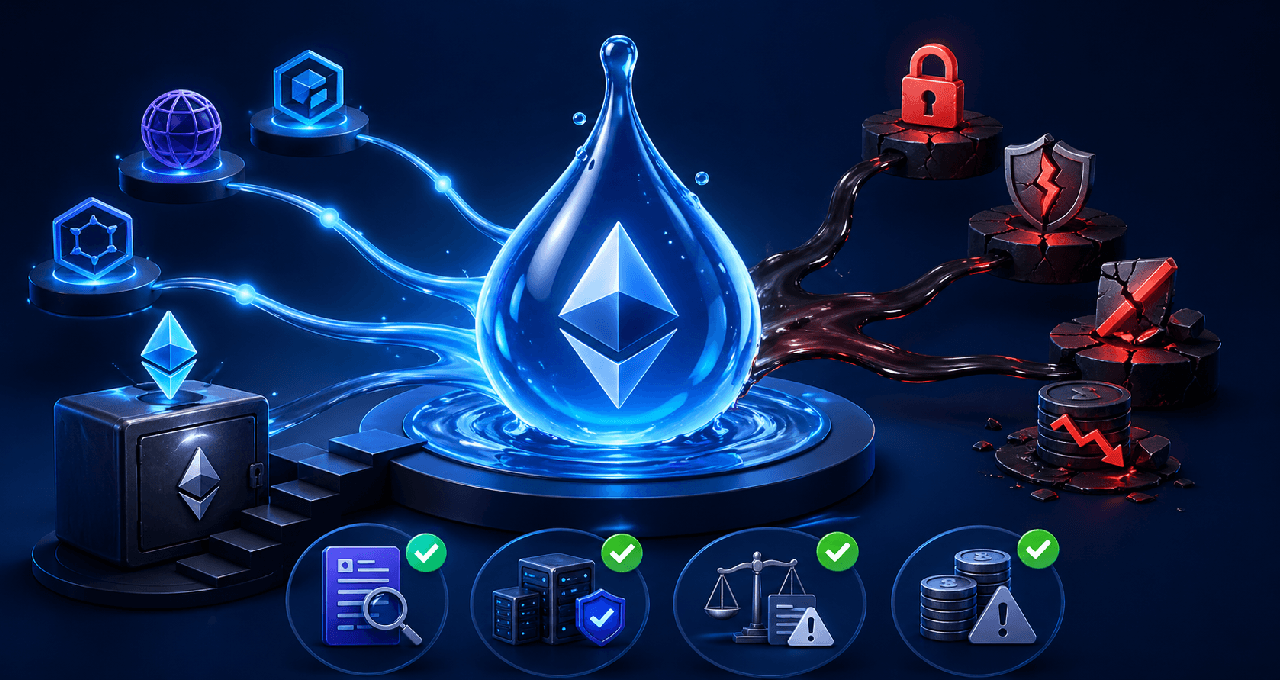
LRTs let you earn extra yield on your already-staked ETH by helping secure other networks, but they add new smart-contract and slashing risks on top of normal staking.
Native restaking is complicated and needs 32 ETH plus tech know-how; LRTs make it simple for anyone, but you now depend on extra protocols that can fail.
Always check audits, node operators, AVS slashing rules, and lending risks before you deposit anything.
Think of It Like Subletting Your Savings
Picture this: you put money in a savings account earning 4 percent. A bank offers to lend that same money to three more lenders at once so you get 12 percent total. Sounds amazing, right? But if any borrower defaults, part of your savings could get seized.
That is exactly how liquid restaking tokens work in crypto. This beginner-friendly guide walks you through what LRTs are, how they actually create yield, and the real risks you need to understand before you send a single dollar.
Step One: Understanding Basic Staking on Ethereum
Ethereum uses Proof of Stake. Validators lock up ETH to help confirm transactions and keep the network safe. In return they earn staking rewards, usually around 3 to 4 percent per year (this number changes, so treat it as a rough guide only).
The downside? Once you stake ETH, it is locked. You cannot trade it or use it anywhere else.
Liquid staking protocols like Lido and Rocket Pool fixed this problem. They give you a token (stETH or rETH) that represents your staked ETH. You can trade or lend that token in DeFi while your original ETH keeps earning rewards in the background.
What Is Restaking? The EigenLayer Model
EigenLayer, launched in 2023, took things further. Instead of your staked ETH only protecting Ethereum, it can now protect many other networks and services at the same time. These services are called Actively Validated Services, or AVSs.
Examples of AVSs include data availability layers, oracles, bridges, and cross-chain messaging. In exchange for the extra security, restakers earn extra yield on top of normal Ethereum staking rewards.
The trade-off is clear: every new AVS adds its own slashing rules. If something goes wrong with an AVS or the operator running your node, part of your ETH can be permanently taken (slashed).
How the Layers Stack Up
Think of it in three simple layers:
Layer 1: Ethereum (base staking rewards)
Layer 2: EigenLayer (extra security collateral)
Layer 3: AVSs (individual services that pay you extra yield)
Native restaking means you do everything yourself directly on EigenLayer. That requires at least 32 ETH, running your own validator or choosing an operator, and a good bit of technical skill.
What Are Liquid Restaking Tokens (LRTs)?
LRT protocols remove all that hassle. You send your ETH (or a liquid staking token like stETH) to a protocol such as EtherFi, Kelp DAO or Renzo. They handle the EigenLayer deposit for you and give you back a liquid token: weETH, rsETH or ezETH.
You can now trade, lend or use that token in DeFi while the protocol manages everything behind the scenes. Your yield comes from three places: Ethereum staking, EigenLayer rewards, and extra payments from the AVSs.
It feels simple and efficient. The catch? You now rely on the LRT protocol’s smart contracts, EigenLayer’s contracts, and any bridge or lending platform where you later use your LRT.
Feature | Native Restaking (EigenLayer) | Liquid Restaking (LRTs) |
Access method | Directly via EigenLayer | Via protocol (Kelp, EtherFi, Renzo) |
Minimum ETH | 32 ETH | Any amount |
Token you receive | None (position stays locked) | rsETH, weETH, ezETH |
Smart contract risk | Lower | Higher (more contracts involved) |
Flexibility | Low | High |
User complexity | High | Low (protocol handles it) |
Slashing responsibility | Direct to you | Delegated to the protocol |
Popular LRT Protocols (As of Early 2026)
Here is a clear comparison of the main players. I have added a Beginner Friendliness Rating (0-5) based on TVL size, incident history, and overall ease plus safety for new traders (5 = most beginner-friendly). Always check latest data on DeFiLlama before you deposit.
Protocol | Token | Underlying Asset | Notable Context | Beginner Rating (0-5) |
EtherFi | weETH | ETH | Largest LRT by TVL | 4.5 |
Kelp DAO | rsETH | stETH | Experienced a bridge-related incident in 2024 | 3.0 |
Renzo | ezETH | ETH | Had a depeg event in April 2024 | 2.5 |
Swell | rswETH | ETH | Offers both liquid staking and restaking | 4.0 |
Note: TVL and rankings change fast. Visit DeFiLlama.com for the latest numbers and any new incidents.
The Risks You Cannot Ignore
Here are the six biggest risks explained in plain English:
Smart Contract Risk
Your money touches at least three layers of code. A bug in any one of them can cause losses.Slashing Risk
The protocol chooses node operators and AVSs. If an operator messes up, your ETH can be slashed. Most protocols keep a small insurance buffer, but it may not cover big problems.Depeg Risk
Your LRT should stay close to the price of ETH. In a panic or exploit it can drop suddenly. The Renzo ezETH depeg in April 2024 caused liquidations for people using it as collateral.Bridge Dependency Risk
When LRTs move between blockchains, bridges can fail. Kelp DAO had exactly this issue in 2024.Collateral Risk on Lending Platforms
Many people deposit LRTs on Aave or Morpho to borrow more ETH and restake again. If the LRT depegs, you get liquidated fast.Withdrawal Queue Risk
Getting your money out is not instant. Queues on EigenLayer plus protocol delays can leave you stuck during a market crash.
2026 Context
As of early 2026, EigenLayer has a huge amount of restaked ETH. Most AVSs had not turned on real slashing yet, so yields felt “free.” That is changing. More AVSs will activate slashing, which means the real risk level is rising.
Before You Restake: A 6-Point Checklist
Answer these questions honestly before you deposit:
Have I read the latest smart contract audit reports?
Do I know which node operators and AVSs my money is delegated to?
Am I comfortable with the slashing rules for every AVS?
If I plan to use the LRT as collateral, do I understand the liquidation rules?
If I am using a bridge to another chain, has that bridge been audited?
Can I afford to lose this entire deposit if something goes wrong?
If you answered “no” or “I’m not sure” to any question, do more homework first.
Securing Your Crypto Assets
For any serious amount of crypto (including LRTs), use a hardware wallet like Ledger. It keeps your private keys offline and protects you from phishing and browser attacks.
FAQ
What is the difference between stETH and weETH?
stETH is a liquid staking token from Lido (just staked ETH). weETH is a liquid restaking token from EtherFi (staked ETH that is also restaked on EigenLayer). weETH carries extra protocol risk because it depends on both Lido and EigenLayer.
Can I lose my original ETH in a restaking protocol?
Yes. Slashing or a smart-contract exploit can reduce your principal. Restaking is a risk-bearing activity, not a guaranteed savings account.
Is restaking available on blockchains other than Ethereum?
EigenLayer is built for Ethereum. Other chains have similar ideas, but Ethereum has the biggest and most developed restaking ecosystem in 2026.
What does TVL mean in DeFi?
Total Value Locked — the total dollar value of crypto sitting inside a protocol. Higher TVL usually signals more trust, but it is not a safety guarantee.
Where can I track LRT protocol data?
DeFiLlama.com gives free real-time TVL charts, yield data, and a hacks database for every major LRT.
Need deeper training?
Join our structured modules with live examples and expert checklists for effective implementation.
JOIN THE ACADEMY