Key Takeaways
|
The Deadline Is Real This Time
In just a few days, the European Union’s new crypto law, called MiCA (Markets in Crypto-Assets regulation), becomes fully enforced. July 1, 2026 is not a soft deadline. The EU’s financial regulator, ESMA, confirmed in April 2026 that there will be no extensions, no exceptions, and that all 27 EU countries will enforce it at the same time.
Here’s what that means in plain English: every crypto exchange or broker that serves EU customers without a valid license must stop operating on July 1. Not gradually. Not next quarter. Stop.
The numbers are striking. Of roughly 1,200+ crypto firms that were previously registered under various national rules across the EU, only around 200 have obtained full MiCA authorization. That means about 80% of the market is either scrambling for a license or quietly planning to block EU users.
Right now, an estimated 7.6 million European crypto users are on exchanges that have no MiCA license. Those users don’t disappear after July 1. They need a new home.
What Is MiCA and Why Does It Exist?
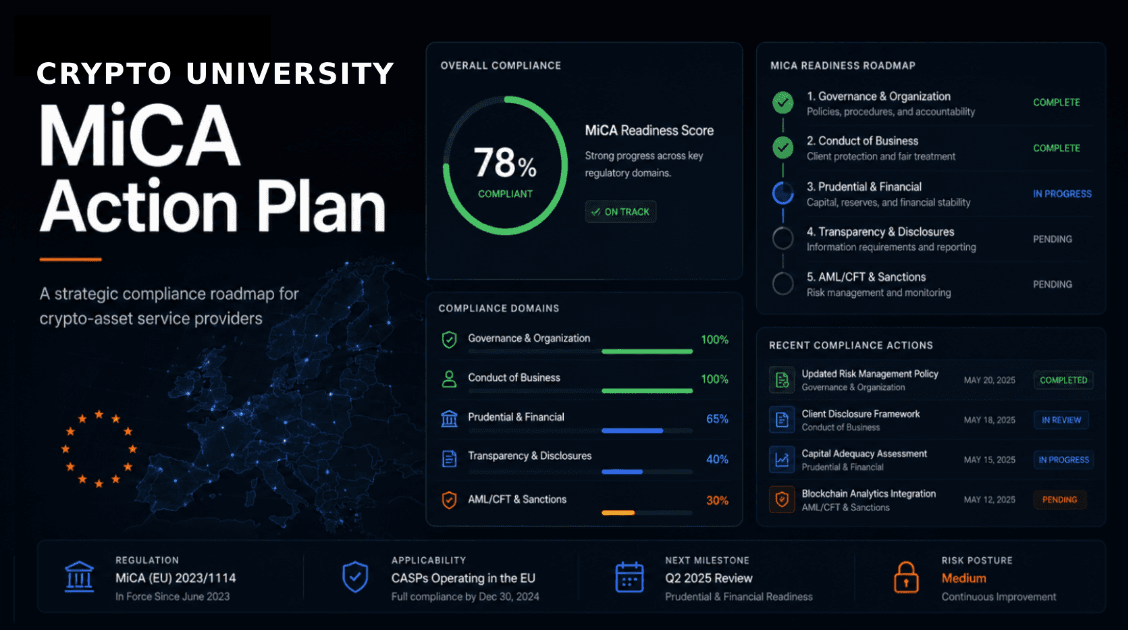
MiCA is the EU’s rulebook for the crypto industry. Think of it like a banking license system, but for crypto. It was officially adopted in June 2023 and rolled out in stages, first covering stablecoins, then expanding to exchanges and other crypto service providers from June 2024, with an 18-month adjustment window that ends July 1, 2026.
The core idea is simple: any business offering crypto services to EU customers must get a CASP license (Crypto-Asset Service Provider) from a national regulator in at least one EU country. Once licensed in one country, the business can operate across all 30 EEA countries automatically, which is why Malta, Luxembourg, Austria, and Ireland have become popular licensing hubs. Get one license in Dublin, serve all of Europe.
What does MiCA require from licensed exchanges? Quite a lot:
Requirement | What It Means for You |
|---|---|
KYC Verification | You must verify your identity (ID, proof of address) |
AML Controls | Exchanges must monitor for suspicious activity |
Capital Requirements | Exchanges need at least €150,000 in reserve capital |
Custody Protections | Your funds must be kept separate from the exchange’s own money |
Consumer Disclosures | Exchanges must clearly explain risks, fees, and terms |
Ongoing Reporting | Regular audits and reporting to regulators |
The exchanges that avoided these requirements were often smaller offshore platforms that relied on low-friction, no-KYC sign-ups. MiCA makes that model incompatible with serving EU users and that’s intentional.
Why Did So Many Exchanges Not Bother?
Getting a MiCA license is expensive. The compliance cost runs between €500,000 and €2 million in year one alone, with ongoing annual costs of at least €250,000. For major exchanges, that’s manageable. For smaller platforms or offshore operations, it’s simply not worth it.
Many exchanges made a business decision: the EU retail crypto market wasn’t worth the cost and the restrictions. MiCA also limits certain product types and requires the kind of customer oversight that many offshore platforms have always avoided.
The result is a mass market exit that has been building for months. Platforms have been quietly blocking EU IP addresses, restricting EU registered accounts, and in some cases going silent about their plans. If you’re still on one of these platforms, your window to withdraw funds and move is narrowing fast.
Which Exchanges Can You Actually Use?
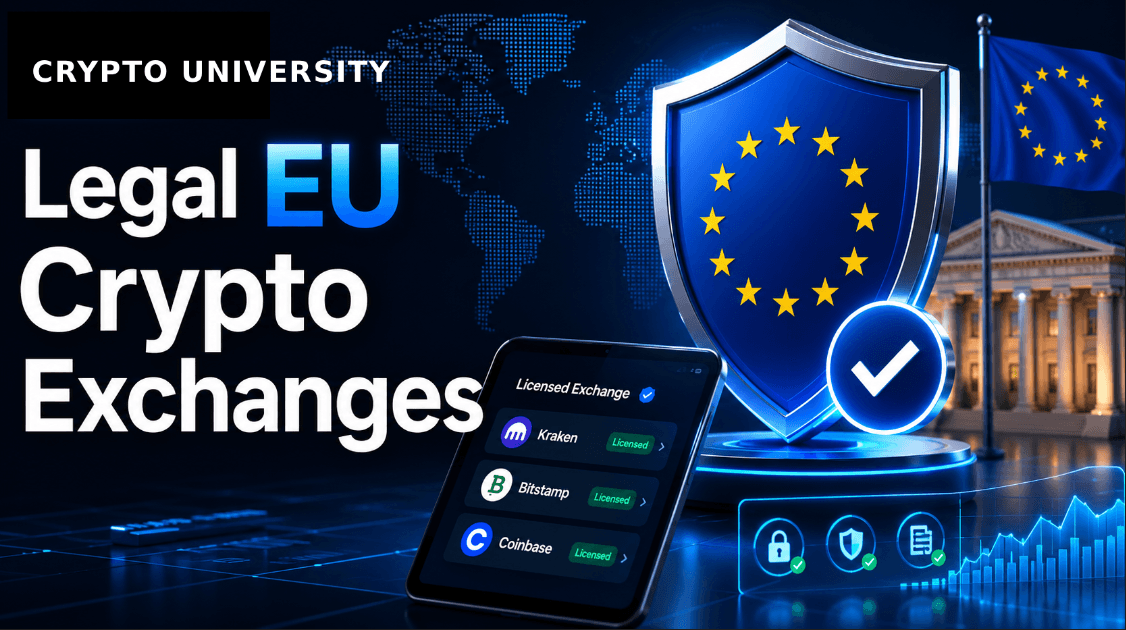
Licensed Exchanges (Safe for EU Users)
Exchange | Licensed In | Notes |
|---|---|---|
Malta (MFSA) | One of the first major global exchanges licensed. Deep order books, broad asset selection, strong EU product offering. | |
Bybit EU | Austria (FMA) | Clean MiCA transition. EU users now use bybit.eu. Strong derivatives offering, well-regarded for execution quality. |
Coinbase | Luxembourg (CSSF) | First US exchange to obtain MiCA CASP license (June 2025). Trusted brand, beginner-friendly. |
Kraken | Ireland (CBI) | Licensed through Payward Europe Limited. Long track record, strong security reputation. |
Bitstamp | Luxembourg (CSSF) | One of Europe’s oldest exchanges, now MiCA-licensed. Conservative and reliable. |
Bitpanda | Austria / Malta | Austrian-born exchange built specifically for European retail investors. |
Bitvavo | Netherlands (AFM) | Largest Dutch retail crypto exchange, among the first fully authorized. |
Malta (MFSA) | Operating through Foris DAX Europe. Large user base but more complex fee structure. |
Exchanges Leaving or Already Gone
Exchange | Status | What You Should Do |
|---|---|---|
MEXC | No MiCA license, no application announced | Withdraw funds immediately |
HTX (Huobi) | No MiCA license, no application announced | Withdraw funds immediately |
KuCoin EU | Austrian FMA license obtained, but banned from new customers due to AML failures | Verify your account status directly with KuCoin |
Binance | Complicated — French entity (Binance France S.A.S.) holds AMF authorization, but not straightforward for all EU users | Check if your account is on the EU-licensed entity |
Dozens of small exchanges | Have quietly exited — geoblocking EU addresses or sending withdrawal notices | If in doubt, withdraw now |
What Happens to 7.6 Million Users After July 1?
Don’t panic. Your crypto doesn’t vanish the moment July 1 arrives. What happens depends on how your exchange handles its exit.
The good outcome: the platform sends clear withdrawal notices, gives you enough time to move your funds, and shuts down in an orderly way. MiCA’s rules actually require this. Exchanges must have proper wind-down plans before the deadline.
The bad outcome: a platform scrambles to block EU users at the last minute, withdrawal queues become overwhelmed, or the platform simply goes dark. In that case, EU users could find their funds temporarily frozen and because the platform was never licensed, there’s no EU regulatory protection for your assets.
The simple advice: if you’re not sure whether your exchange is licensed, withdraw now. Don’t wait until June 29 or 30. Blockchain networks can get congested during peak periods, and exchange withdrawal queues often slow down during high-volume events.
The USDT Situation: What Happened to Tether?
One immediate and concrete change for EU users is the disappearance of USDT (Tether) from licensed exchanges. Tether has no MiCA authorization as an e-money token issuer and has said it has no plans to apply for one. As a result, all licensed EU exchanges have delisted USDT.
Exchange | USDT Delisted |
|---|---|
Coinbase | December 2024 |
January 2025 | |
Binance | March 2025 |
Kraken | End of March 2025 |
If you hold USDT on any exchange right now, convert it to USDC (which is MiCA-compliant since July 2024), EUROC, or fiat before July 1. On an unlicensed platform, there may be no way to convert it after the deadline passes.
Could MiCA Move Bitcoin’s Price?
The MiCA deadline probably won’t cause a sudden Bitcoin price spike like an ETF approval would. But it could matter for the market in ways that play out over time.
Short-Term: Temporary Friction
7.6 million users looking for a new exchange at the same time means a wave of KYC onboarding, fund transfers, and account migrations happening simultaneously. Some users may choose to move their Bitcoin to a personal hardware wallet rather than immediately open a new exchange account. If even a portion of those users park capital in Bitcoin offline, that reduces exchange supply temporarily.
Medium-Term: Institutional Interest
This is the more important dynamic. MiCA creates the regulatory clarity that big institutional investors — pension funds, asset managers, family offices — have been waiting for. They can now engage with crypto through licensed, audited, ESMA-supervised exchanges that satisfy their compliance requirements. Over the next 12 to 24 months, this could bring meaningfully more institutional capital into European crypto markets. More institutional demand, generally speaking, supports Bitcoin’s price over time.
Long-Term: Better Market Structure
As unlicensed platforms exit, trading volume concentrates on 10 to 15 major authorized exchanges. This tends to improve price discovery, reduce manipulation, and tighten spreads — conditions that attract more serious, long-term capital.
None of this is a guaranteed price move. MiCA is one factor among many. But the structural direction — more regulated, more transparent, more institutional — is historically the kind of environment where Bitcoin’s long-term adoption grows.
What Should You Do Before July 1? (Checklist)
Your Situation | Action Required | Urgency |
|---|---|---|
You’re on a licensed platform. Complete any pending KYC verification and check your account status. | Low, you’re fine | |
Using Coinbase, Kraken, Bitstamp, Bitvavo, or Bitpanda | Licensed platforms — no immediate action required. Confirm your account is on the EU entity. | Low |
Using MEXC, HTX, or an exchange you’re unsure about | Withdraw your funds now. Open an account on OKX or Bybit EU, complete KYC, and transfer your assets. | HIGH, act today |
Holding USDT anywhere | Convert to USDC, EUROC, or fiat before July 1. | HIGH |
Wanting to remove exchange risk entirely | Move long-term Bitcoin holdings to a hardware wallet (Ledger or Trezor). No exchange can freeze funds you control yourself. | Medium, good practice anytime |
The Bigger Picture
What MiCA really represents is the EU making a permanent choice about the kind of crypto market it wants. It chose regulated, licensed, audited, KYC-verified exchanges over the offshore, anything-goes model. It prioritized investor protection and market integrity over unrestricted access to every asset and every platform.
You can debate whether that’s the right trade-off. But the decision has been made, and it is now law. The era of operating in Europe through national provisional registrations or light touch offshore structures is over. The exchanges still operating in the EU are the ones that chose to play by the rules.
For you as a user, the choices you make right now, which platforms you use, which assets you hold, where your funds sit on July 1, will be shaped by a regulatory framework that is here to stay.
Frequently Asked Questions
What is MiCA?
MiCA stands for Markets in Crypto-Assets Regulation. It’s the EU’s comprehensive law for the crypto industry, requiring all exchanges and crypto service providers to obtain a CASP license to legally serve EU customers. It became fully enforceable on July 1, 2026.
What happens if my exchange isn’t MiCA-licensed?
It must stop serving you as an EU user. You may receive a notice to withdraw your funds. If the platform doesn’t handle its wind-down properly, access to your assets could be disrupted. The safest step is to withdraw before July 1.
Which exchanges are safe to use in Europe?
Confirmed licensed exchanges include OKX, Bybit EU, Coinbase, Kraken, Bitstamp, Bitpanda, Bitvavo, and Crypto.com. For the full official list, check the ESMA Interim MiCA Register at esma.europa.eu.
Does MiCA affect Bitcoin itself?
No. Bitcoin as an asset is not regulated by MiCA. The regulation only governs the service providers (exchanges, custodians) operating in the EU. Your Bitcoin remains yours regardless of exchange regulation.
Why was USDT removed from EU exchanges?
Tether has not applied for MiCA authorization as an e-money token issuer. Without that authorization, licensed EU exchanges cannot legally offer USDT trading to EU customers.
Is there a grace period after July 1?
No. ESMA confirmed in April 2026 that there will be no extensions. July 1, 2026 is the hard enforcement date across all 27 EU member states.
What’s the difference between USDT and USDC under MiCA?
USDC (issued by Circle) obtained MiCA authorization as an e-money token in July 2024 and is legal to trade on licensed EU exchanges. USDT (issued by Tether) has not sought MiCA authorization and has been delisted from all licensed EU exchanges.
Disclaimer: This content is for educational and informational purposes only and is not financial advice. Nothing here is a recommendation to buy or sell any asset or use any platform. Do your own research and manage your risk.
How to Safely Use Crypto Bridges in 2026: Risk Assessment Checklist and Best Practices
AI Agents and Crypto: A Beginner's Guide to Autonomous On-Chain Payments
How to Evaluate a Web3 Protocol: An On-Chain Due Diligence Framework