Introduction
When people ask “Which countries hold the most Bitcoin?”, they usually want a clean leaderboard.
In reality, government Bitcoin holdings are one of the most misreported topics in crypto.
There are three reasons:
Governments rarely publish wallet addresses.
A large share of “government BTC” comes from law enforcement seizures, and those assets can be tied up in court for years.
Even when a government controls Bitcoin at some point, it may later sell, return, or redistribute it, and public reporting often fails to track those changes.
This article is built as a serious educational resource.
You will learn:
What counts as a country holding Bitcoin
The main acquisition pathways (seizures, treasury buys, mining)
A top-10 list of countries most often cited as major holders in 2026
How to verify government BTC claims using primary sources and on-chain data
Scope:
This article focuses on government-controlled or government-owned Bitcoin, not private citizens, companies, or exchanges.
Understanding “Government Bitcoin”
Government-Owned vs Government-Controlled
Two categories matter:
Government-Owned Bitcoin
The state is the legal owner
Example: treasury purchase or court-ordered forfeiture
Government-Controlled Bitcoin
Agencies hold the keys during investigations or litigation
Ownership may still be disputed
Many rankings mix these categories without explaining the difference.
Custody vs Ownership
A country hosting exchanges or custodians does not mean the government owns those coins.
Always ask:
Is the BTC owned by the government?
Held by private companies?
Or simply passing through local infrastructure?
Seizure Announcements Are Not Final Balances
After seizure, coins may:
Be held as evidence
Be returned to victims
Be auctioned
Be sold through brokers
Be transferred to custody wallets
Tracking only the initial seizure number can be misleading.
How Governments Acquire Bitcoin
1. Law Enforcement Seizures
This is the largest source of government Bitcoin.
Typical process:
Bitcoin is seized during investigation
Held during legal proceedings
Court determines forfeiture
Government may hold, auction, sell, or distribute proceeds
Key point: “Seized” does not mean “owned.”
2. Treasury Purchases
Some governments intentionally buy Bitcoin.
Typical process:
Government announces purchases
Details may be partial
Coins may be custodied by third parties
Exact balances are often estimates.
3. State-Linked Mining
Government-related mining operations may exist through:
State-owned utilities
Sovereign investment funds
Public-private mining partnerships
Claims of sovereign mining are often overstated.
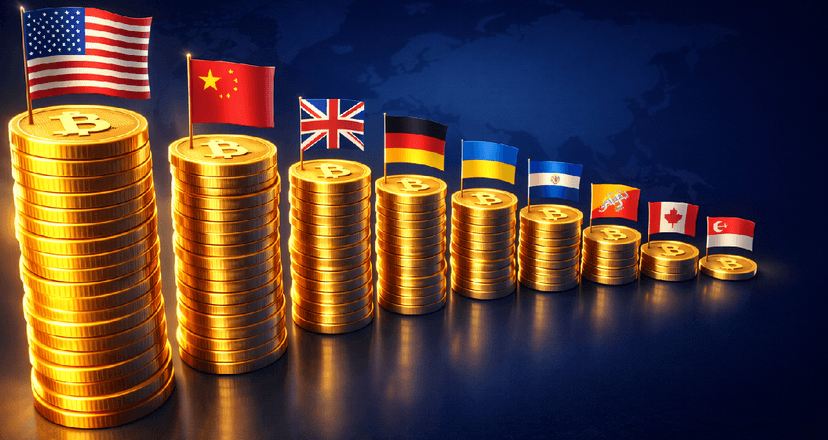
Top 10 Biggest Bitcoin-Holding Countries (2026)
Rank | Country | Primary Acquisition Method(s) | Key Notes / Estimates (2026) | Verification Methods |
1 | United States | Darknet seizures, ransomware, forfeitures | Widely reported as largest holder; ~198,000–328,000 BTC from various seizures; some held in Strategic Bitcoin Reserve | Department of Justice announcements, court filings, public auction disclosures; on-chain if addresses published |
2 | China | Large enforcement actions, scam seizures | Often cited with high estimates (~190,000–194,000 BTC); limited transparency | Specific seizure events, cross-check reputable reporting; avoid single wallet claims |
3 | United Kingdom | Money laundering, fraud, proceeds-of-crime | ~61,000 BTC commonly reported | Police announcements, court confiscation orders, custody reporting |
4 | Germany | Law enforcement seizures, criminal proceeds | Entered discussions after major events | Official announcements, on-chain movements linked to authorities |
5 | Ukraine | Crypto donations (wartime), seizures | ~46,000 BTC in some reports; donations often spent | Official donation addresses, transparent reporting |
6 | El Salvador | Treasury purchases, policy alignment | Openly holds BTC as legal tender (~6,000–7,500 BTC) | Official statements, address disclosures, independent reporting |
7 | Bhutan | State-connected hydropower mining | Linked to mining; holdings reduced in 2026 (~5,400 BTC after sales) | Evidence of state facilities, mining partnership reporting |
8 | Canada | Financial crime seizures | Appears due to major cases | Police announcements, court records |
9 | Singapore | Financial hub (often misidentified) | Minimal government ownership; mostly private/exchanges | Confirm state-owned vs private holdings |
10 | Iran | Mining policy | Associated with permissions; limited reserves evidence | Official policy statements, state mining evidence |
How to Verify Government Bitcoin Holdings
Step 1: Identify the Acquisition Event
Look for:
Seizure
Treasury purchase
Mining program
Court judgment
Without an event, the claim is likely speculation.
Step 2: Find Primary Documents
Examples include:
Court documents
Government gazettes
Agency press releases
Treasury reports
Step 3: Separate Gross vs Net Holdings
Ask:
Was the BTC forfeited?
Was it sold?
Returned to victims?
Still under litigation?
Step 4: Use On-Chain Data Carefully
On-chain analysis works best when:
Wallets were published
Court filings reference addresses
It is unreliable when based on anonymous labels.
Step 5: Track Liquidation and Transfers
Exchange transfers may indicate selling, but can also mean:
Custody restructuring
Transfers between government wallets
Treat movements as signals, not proof.
Why Government Bitcoin Holdings Matter
1. Governance
Handling of seized BTC affects public trust in asset forfeiture and custody standards.
2. Market Liquidity
Large government liquidations can influence market liquidity.
3. Regulatory Precedent
Government BTC cases shape how crypto is treated legally and for taxation.
4. Geopolitics
Bitcoin is frequently used in geopolitical narratives and propaganda.
Practical Takeaways
Treat rankings as leads, not sources
Ask whether BTC was seized, purchased, or mined
Distinguish owned vs controlled
Verify with documents first
Accept uncertainty
FAQ
Do central banks hold Bitcoin?
Direct central bank BTC reserves are rare. Most government BTC comes from seizures or treasury policies.
Why is the US often ranked near the top?
Because of repeated large seizures and transparent legal processes.
Can governments secretly hold Bitcoin?
Possible, but claims without documentation should be treated as unconfirmed.
How do governments sell seized Bitcoin?
Common methods:
Auctions
Brokers
Approved intermediaries
Are the rankings exact?
No. They are estimates based on public data and reporting.