
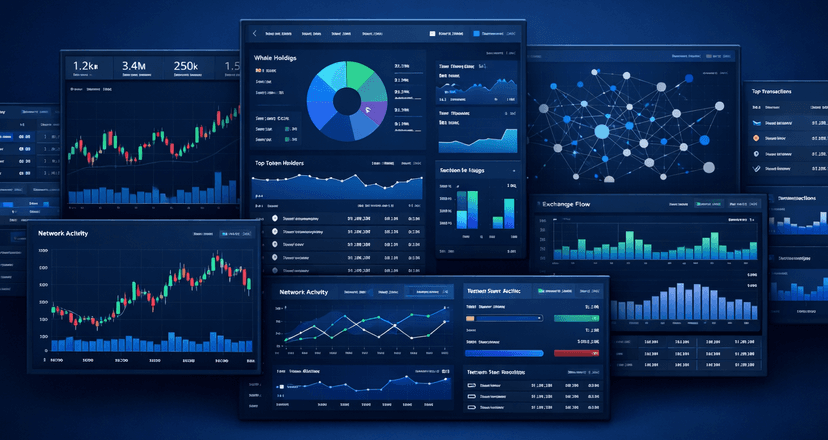
The world of cryptocurrency is often loud and confusing, with countless voices claiming to have the definitive insight. Amidst this noise, on-chain data offers a beacon of transparency, revealing the true movements and activities on a blockchain. This guide cuts through the speculation, providing a clear framework to leverage on-chain data effectively and avoid common misinterpretations.
On-chain data refers to all information recorded on a public blockchain ledger, including transaction details, wallet addresses, smart contract interactions, and network activity. This immutable record provides a verifiable source of truth regarding the state and evolution of a decentralized network.
Why It Matters
- Transparency: Offers a direct, unfiltered view of market dynamics, unlike traditional markets that rely on intermediaries.
- Early Signals: Can reveal shifts in sentiment or accumulation patterns before they manifest in price action.
- Risk Management: Helps identify potential market manipulation or unsustainable project activity.
- Fundamental Analysis: Provides insights into network health, adoption rates, and user behavior.
How It Works
1. Identify Your Goal: Determine what specific question you want on-chain data to answer (e.g., Is there whale accumulation? Is exchange supply decreasing?).
2. Select Relevant Metrics: Choose appropriate metrics based on your goal, such as active addresses, transaction volume, exchange netflow, or stablecoin supply ratio.
3. Collect Data: Utilize reputable on-chain analytics platforms (e.g., Glassnode, Nansen, Dune Analytics) to gather the necessary data points.
4. Analyze Trends, Not Snapshots: Look for sustained patterns and trends over time, rather than reacting to single data points.
5. Contextualize with Market Data: Always cross-reference on-chain findings with price action, macroeconomic factors, and news events.
6. Formulate a Hypothesis: Develop a reasoned conclusion based on your analysis, acknowledging potential limitations.
Example with Realistic Numbers
Consider a scenario where Bitcoin (BTC) is trading at $60,000. An analyst observes a consistent trend of decreasing Bitcoin balances on major exchanges over the past three months, with a net outflow of approximately 50,000 BTC. Simultaneously, the number of active addresses holding more than 1,000 BTC has increased by 5% in the same period. This suggests that large holders are moving their Bitcoin off exchanges, often a precursor to long-term holding or staking, reducing immediate selling pressure. While not a guarantee of price increase, this on-chain signal, combined with stable price action, could indicate underlying accumulation and strong holder conviction, contrasting with a scenario where exchange inflows are high, signaling potential selling.
Common Mistakes
- Cherry-Picking Data: Focusing only on metrics that support a preconceived narrative.
- Ignoring Context: Analyzing on-chain data in isolation without considering broader market conditions or news.
- Misinterpreting Whale Movements: Assuming large transactions always signal market manipulation; they can also be internal transfers or institutional rebalancing.
- Short-Term Focus: Over-relying on daily fluctuations rather than long-term trends.
- Lack of Verification: Not cross-referencing data across multiple platforms or sources.
Quick Checklist
- Define your analytical question clearly.
- Choose appropriate metrics for your objective.
- Look for sustained trends, not isolated events.
- Integrate macro and market context.
- Consider multiple data sources for validation.
- Be aware of potential data lags or reporting discrepancies.
- Avoid emotional reactions to data; maintain objectivity.
Related Terms
- Active Addresses
- Exchange Netflow
- Whale Wallets
- Stablecoin Supply Ratio
- Realized Price
- HODL Waves
FAQs
Q: What is on-chain data?
A: On-chain data refers to all publicly recorded and verifiable information on a blockchain, including transactions, wallet addresses, and smart contract interactions.
Q: How can on-chain data be misleading?
A: On-chain data can be misleading if interpreted without proper context, by cherry-picking metrics, or by failing to understand the nuances of specific blockchain activities.
Q: What are some key on-chain metrics to watch?
A: Important metrics include active addresses, transaction volume, exchange netflow, stablecoin supply ratio, and realized price.
Q: Is on-chain data predictive of price movements?
A: While on-chain data can provide strong indications of market sentiment and supply/demand dynamics, it is not a direct predictor of future price movements and should be used with other forms of analysis.
Q: Where can I access on-chain data?
A: Reputable platforms like Glassnode, Nansen, and Dune Analytics provide comprehensive on-chain data and analytical tools.
Q: How often should I check on-chain data?
A: For trend analysis, it’s more effective to review on-chain data over longer periods (weeks or months) rather than focusing on daily fluctuations, which can be noisy.
Sources
Glassnode, Coin Metrics, Nansen, CryptoQuant
Disclaimer
This article is for informational purposes only and does not constitute financial advice. Cryptocurrency investments are volatile and high-risk. Always conduct your own research and consult with a qualified financial professional before making any investment decisions.